Site-Specific Video Installation
Site-specific video installations are multi-channel video works where socially engaged art practice meets video projection design. Each piece is an embodied experience, attuned to a particular location and community, inviting viewers to experience themselves in relationship with others through mediated, affective environments.
Artist's Statement
I make work that rises organically in response to, and in conversation with, people whose lives resonate with the social, cultural, and political issues I feel compelled to address. The work does not exist without them.
My practice draws on socially engaged art, dialogical aesthetics, and critical pedagogy to create situations where intersubjective exchange—speaking and listening across difference—becomes a primary medium. I am interested in how the face-to-face encounter with a radical other can shift what is possible in public and civic life: how presence, testimony, and authentic voice that offers vulnerability and empathetic resonance in shared spaces can do what policy alone cannot.
This requires a particular ethics of process. I enter communities as a guest, not an authority. I bring formal and conceptual skills; my collaborators bring lived expertise, personal knowledge, and a stake in the outcome that I cannot replicate. What is made in that exchange—new ways of knowing & new ways of being in relation—is the work, and the relationships I form with collaborators are the foundation for the work to take place.
I cannot separate art and image making from ethics. Every decision about representation, authorship, and public engagement is also a relational decision. For me, this is a generative constraint—it is what makes the work worth doing.
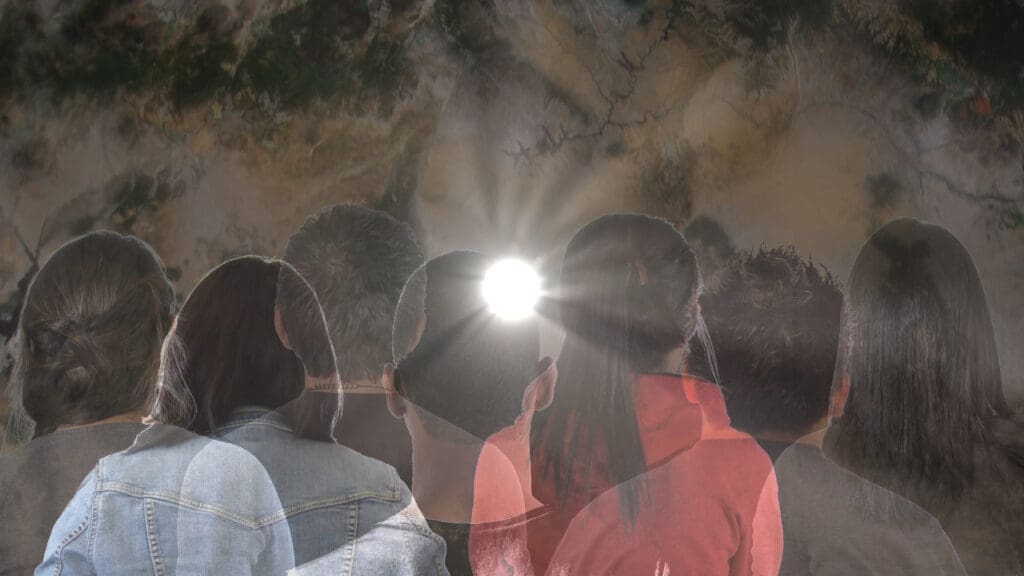
My Future Is Here
Site-specific installation and public event. Flushing International High School, Queens, New York, 2012.
My Future Is Here was a multimedia installation produced in collaboration with immigrant youth from Flushing International High School in Queens, New York. Working with seven student collaborators from Tibet, Nepal, India, Ecuador, El Salvador, the Dominican Republic, and Mexico, the project brought personal narratives of migration into public space through video, sound, and participatory content design.
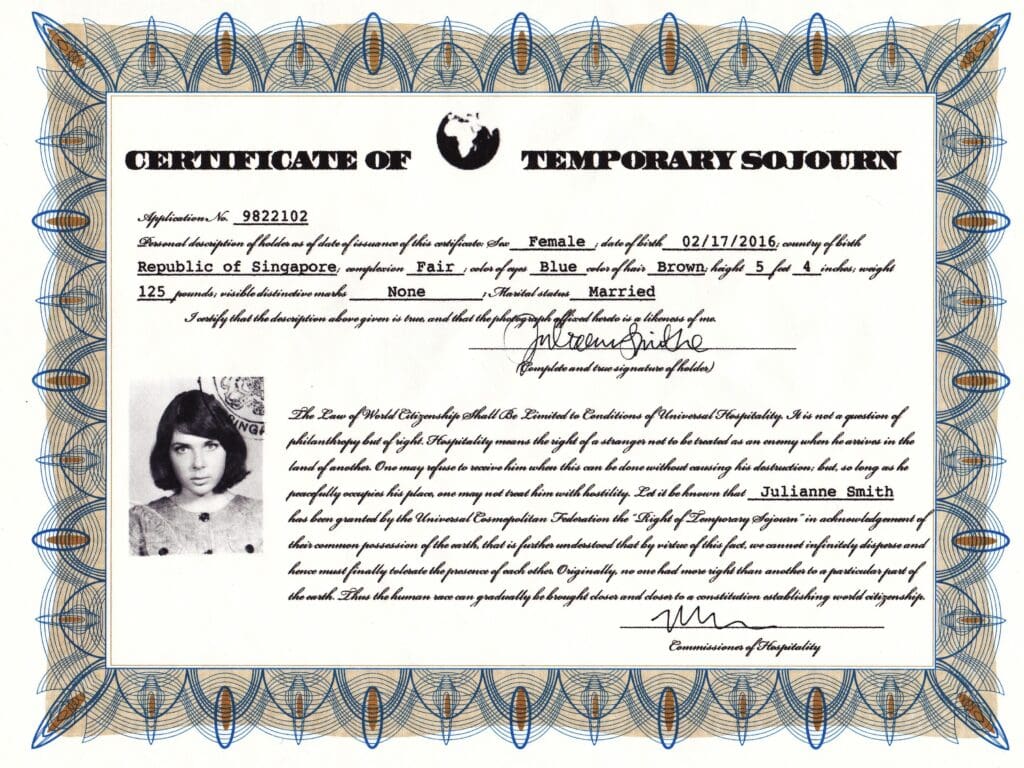
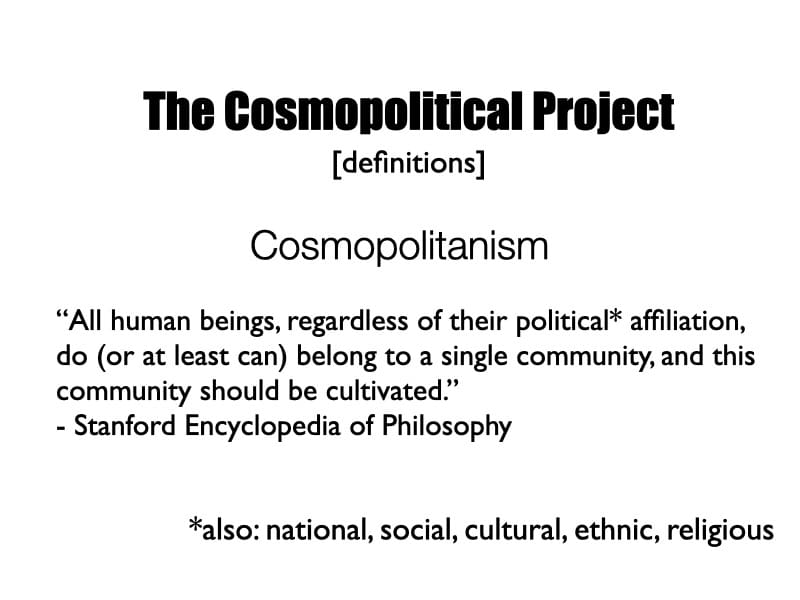
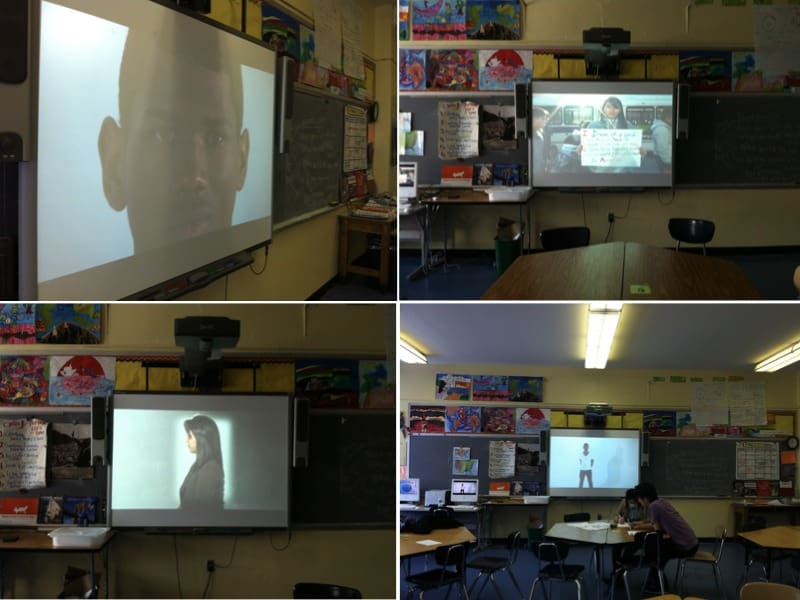
The installation transformed the school’s hallways and classrooms into an experiential journey. Guests applied for visas at the entrance, moved through rooms that were transformed into each student-collaborator’s life-world, where their stories played on Smart Boards and other screens in the room—the students themselves present at the threshold—and upon completing the journey, received a Certificate of Global Citizenship designed collectively by the collaborators. Conversation tables lined the hallway where guests were invited to respond to questions the students wrote: What is your definition of global citizenship? Are borders important? What makes a nation?
The project operated at the intersection of social practice, critical pedagogy, and community-based media art, centering the voices and self-representation of immigrant youth as both its method and its outcome.
The project began in September 2011 with a dinner conversation in Queens and a question: what would it look like to make a community-based media art project that centered the ethics of hospitality — with the people who understand that question most intimately?
Flushing International High School serves recently arrived immigrant youth and English Language Learners from across Asia, Central and South America, the Caribbean, and beyond. From the first visit, what distinguished the school was not its diversity on paper but what that diversity looked like in practice: students navigating second languages and new cultures while carrying the weight of family sacrifice, legal precarity, and interrupted childhoods.
The core group of seven collaborators came together through the school’s DREAM Team, a student organization advocating for undocumented youth. Each brought a distinct history: Dewa from Tibet, who had lost her mother to political imprisonment; Edgar from Ecuador, reuniting with his mother, whom he had not seen in five years; Marco, undocumented, who had crossed the Mexican desert at thirteen; Ana, a U.S. citizen who had grown up in El Salvador and been interrogated at customs for not speaking English.
Speaking to Publics
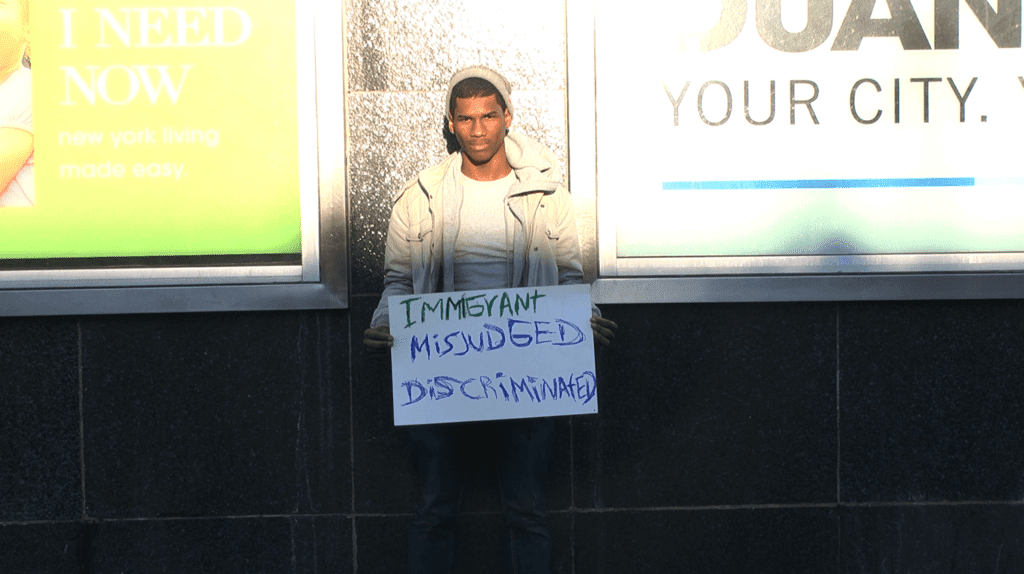
The first production phase took place in the streets of Flushing. Students wrote personal statements on poster board—My family sacrificed comfort, the union of family, luxury, close friends to come to this country; Immigrant, Misjudged, Discriminated; I dream of a world where there is peace for immigrants—and held them up on a public sidewalk while I filmed. Passersby stopped. Some debated. Some stayed long enough to talk about deportation, globalization, the contributions immigrants make.
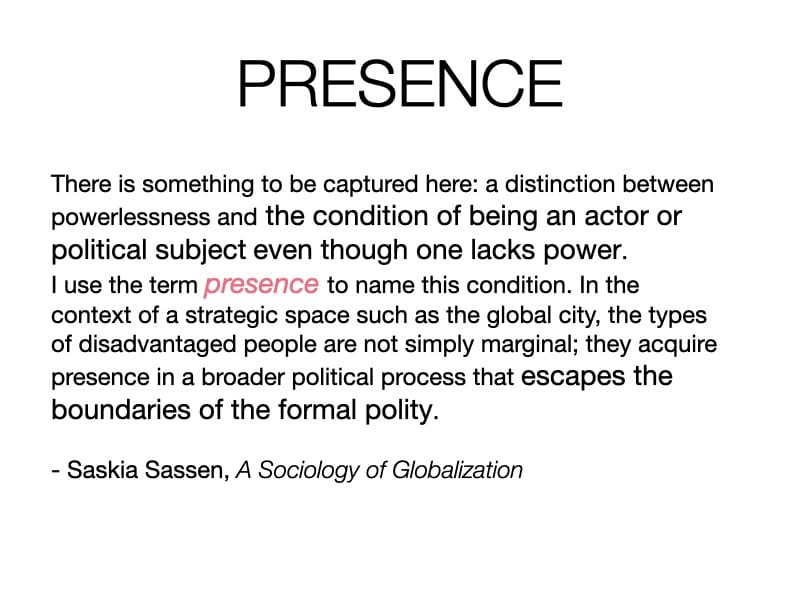
The conceptual grounding for this exercise came from sociologist Saskia Sassen’s concept of presence—a distinction she draws between powerlessness and political subjectivity. An immigrant youth may lack legal or institutional power, but that does not make her a passive actor. Within the strategic space of the global city, Sassen argues, people without formal political standing can still acquire presence: they enter broader political processes, claim space and time, and constitute informal polities that transcend national attachments. Making signs that were political through the personal, and holding them up in public for strangers to read, was an exercise in exactly this. I did not have to teach the students the significance of the action—there was already a visual and discursive understanding each of them brought to it. What the project provided was a framework, a camera, and a public.
The resulting video series, Speaking to Publics, was slowed to one percent of normal speed—crowds and shadows moving in dreamlike currents around each student, still and present at the center, holding their sign, claiming space. The choice was deliberate: in a media environment that moves faster than comprehension, the viewer must slow down, attend, and listen:
The foreigner needs to speak.
Process Notes
Truth-Telling and Transformation
One of the project’s most significant developments was not planned.
When Marco first agreed to participate, he set firm conditions: he would remain anonymous, and he would tell his story in Spanish. Marco had founded the school’s DREAM Team and was himself undocumented, having crossed the Mexican desert alone at thirteen. He was cautious, thoughtful, and clear about the risks of visibility.
Between January and March 2012, Marco began working with the New York State Youth Leadership Council, participating in campaigns that encouraged undocumented youth to share their experiences publicly—to refuse to live in the shadow of shame or fear. He attended events. He heard others speak. Something shifted. He wrote to say he no longer wanted to be anonymous. He would tell his story in English, and he would use his name.
When he sat down in front of the camera, he said:
I am one of those who crossed the border without papers — but I am proud of who I am.
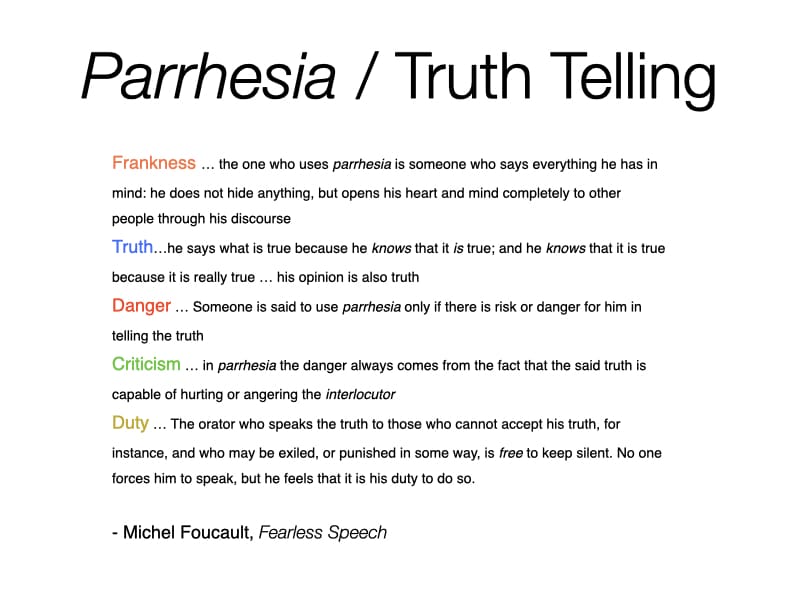
This arc—from careful anonymity to named, public self-declaration—is what the philosopher Michel Foucault called parrhesia: a form of truth-telling that carries personal risk, is spoken out of duty rather than compulsion, and is directed at those with the power to harm the speaker. The parrhesiastes does not simply share information; they speak a truth that could cost them something, because they believe it must be said. For an undocumented young man to name himself, in English, on camera, in a country that could deport him, is an act of precisely this kind of courage.
Each student in this project practiced parrhesia to different degrees—through the public sign-holding, through the recorded testimonies, through standing in the installation and taking questions from strangers. Their truths were hard-won: experiences of refugeeism, racism, family separation, economic sacrifice, and witnessing the deportation of peers. To speak these truths in a foreign tongue, to hold them up on a street corner or a gallery wall, is not simply self-expression. It is a claim on public life.
Recording the Stories
In a Brooklyn studio, each student was given forty minutes to an hour on camera to tell their story of migration. For several, it was the first time they had spoken about these experiences freely. A few were overcome with emotion. All of them continued.
The editing process was collaborative throughout: drafts were shared, students gave feedback, and every representational choice was made in dialogue. Each collaborator had also taken cameras home over the course of the project to collect images of their lives. This footage was layered into their narrative piece. The videos were structured to begin with the student’s back to the camera—withholding identity, foregrounding voice—and gradually reveal their faces as the narrative progressed. By the end of each video, you are looking directly at them, unobscured.
The Installation
On June 11, 2012, My Future Is Here opened to the public. Each student’s story occupied its own room in the school, their physical presence alongside their image on screen. Guests moved through the space with visas in hand, stopped at conversation tables to write and discuss, and left with Certificates of Global Citizenship—a document the students designed themselves, articulating the rights they believed should be guaranteed to anyone who crosses a border.
At the closing Q&A, the student-collaborators took questions from the audience. Edgar described gaining confidence the moment strangers approached him on the street in Flushing. Albert spoke about the solidarity that had formed between students who came from entirely different countries but shared the same struggles and dreams. Dewa said the project made her feel proud of herself and her life. Marco said it gave him the opportunity to speak out as an undocumented youth — and that he hoped others in his situation would do the same.
It was not enough for me to initiate and facilitate this work. What mattered was that the students believed in it, and made it their own. To witness them doing so was the project’s most important outcome.
Architectures of Memory
a multi-channel installation for the ocean
Santa Cruz, California
Remembering is a creative act, an act of reconstruction, and because of this, a memory is never the same twice.
How do you remember?
In research, we conducted interviews asking how memories looked, felt, and sounded for different individuals. We chose to focus on the extremes of memory–happy memories, joyful memories, painful moments, memories you would never want to lose, with the idea that these extremes remain above all else when our memory deteriorates.
Using video to visually interpret our research, Architectures of Memory is a site-specific, thirty minute, three channel video installation exploring the many complexities and poetics of the construction of memory and its erosion within the human brain.
The public art event took place October 21st, 2011 within Mitchell’s Cove at West Cliff Drive and Sunset Avenue in Santa Cruz, California. Images and text were projected on the cliffside, rocks, and waves within the ocean inlet.
Project Directors & Video Producers: Natalie McKeever & HK Park
Project Conception & Video Projection Design: HK Park