曲線의 生活
THE LIFE OF THE CURVE
曲線의 生活
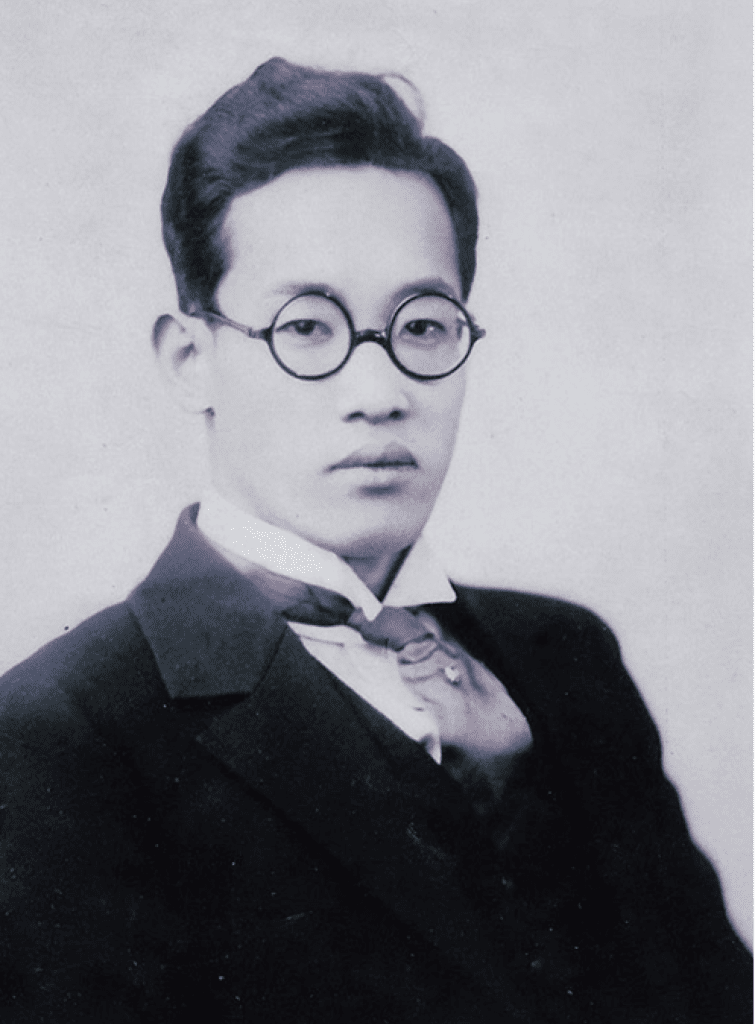
by Kim Cho-seong (Kim U-Jin)
On the day of the founding of Société Mai, June 1925
“The starry heavens above me, the moral law within me.” — This is the golden maxim of the philosopher of Königsberg.
“The blue sky above me, the will-to-live within me.” — This is my own golden maxim.
Friends, what difference is there between these two maxims?⁷ That idealist philosopher lives in order to attain creation, reason, and perfection; I, by contrast, seek creation, reason, and perfection in order to live.
This is no paradox. To put it more simply: life does not lie beneath law — rather, law arises beneath life. The idea of élan vital (the current of life) was already glimpsed by Greek philosophers two thousand years ago; in the nineteenth century the pessimist poet conceived of it as Wille zum Leben (the will to life); and at the beginning of the twentieth century a French philosopher likewise conceived of it as throbbing, pulsing life. We now feel this “will-to-live” within us.
But life is flow, and law is fixity. The weaker the flowing water becomes, the more rigid the formerly fixed law grows. Mould creeps over morality, ideas wither, and cracks split open in statutes and institutions.
To awaken to the force of life, one cannot simply drift along as one pleases — just as one who lies asleep cannot open his eyes, and not opening them cannot see.
The compass-needle of life is consciousness. The “consciousness of life” is the world’s destruction, and equally its creation. Not mere creation, not mere reform — but a creation that repeats itself within every conceivable span of time and space. So do not stop short at the words “reconstruction” or “reform.”
In this “consciousness of life” I place my hope. At the very least, we must see in it the turning-point of our destiny. Of course, the ultimate driving force of life — what philosophers call Ding an Sich (the thing-in-itself), or the “noumenon” — has its own connection to fate; the umbilical cord of fate is no doubt fastened there as well. But Ding an Sich, or the noumenon, lies beyond our knowable world. There is no need to know this something. Look — have plants, rocks, flying birds, or running beasts ever gained more happiness by straining to know this something? Have they ever lived less naturally than this human world of ours? To live “naturally” means not to wander beneath shackles fashioned by one’s own hands.
“Above me, the blue sky; within me, the will-to-live.” It follows that everything which constrains this will-to-live is of secondary order. And because it is secondary, it is sin. It is unnatural, it is unjust. If you would not have this unnatural, unjust, sinful thing, then there must be the “consciousness of life.” Here lies the flow that is human life, and the ceaseless onward march of human life.
The engine of life — not only in humans, but in all the sentient beings of the three thousand worlds (三千世界) — lies hidden forever in the hand of the Creator. But the “consciousness of life” alone is held in our own hands. Look — has there ever been any force without consciousness? Has any flower ever bloomed without it? Has there ever been any conscious living without it? You can find this principle in history, among the people around you, and above all within yourselves.
“Above me, the blue sky; within me, the will-to-live.” The blue sky is the straight line; force is the curve. Where there is no curve, how can there be force? Where there is no force, where is life? Because life has curves, life is the eternally recurring struggle. Throw off everything that is straight. Now is an age when the swell of life must rise once more, more powerfully and more fiercely. An age of great curves has come — an age unmatched in either scale or quality for over two thousand years. Shun every straight-line mode of living. Cast away ideals, concepts, the absolute — all of them. And seize the moment within the flow of life.
To do so, first take hold of the mast of the “consciousness of life.” George Bernard Shaw said, “Heaven is a voyage, and hell is drifting.” That is to say: do not kill instinct, but take it as your compass and swim out upon the great sea of instinct. This is the true paradise. To wander and drift on the waves of instinct, with heaven and earth gone dark, gasping aimlessly without bearing — that is at once hell. So if you would enter paradise, do not look up to heaven. Faithfully know, instead, the raw and tangled naked body of life knotted within you. From that knowing, the great spring-water of life will well up, winding, winding.
— On the day of the founding of Société Mai, June 1925
───────────────────────────────────────────────────────
NOTES
The bracketed Hangul readings ([곡선], [생활], etc.) in the original are pronunciation glosses for Sino-Korean compounds — a standard convention in 1920s Korean print. They are silent in the translation.
The numbered superscripts (¹–²²) preserve the footnote/annotation positions of the source edition for cross-reference.
Kim’s central conceit hinges on a deliberate contrast with Kant’s famous maxim from the Critique of Practical Reason (“Two things fill the mind with ever new and increasing admiration and awe… the starry heavens above me and the moral law within me”). Where Kant places moral law inside the self, Kim places the will-to-live — a Bergsonian / Schopenhauerian / Shavian inversion that runs through the whole essay.
Key allusions: élan vital (Bergson, L’Évolution créatrice, 1907); Wille zum Leben (Schopenhauer, Die Welt als Wille und Vorstellung); Ding an Sich (Kant); 三千세계 (sānqiān shìjiè, the Buddhist “three-thousand-fold world-system”); and Shaw’s contrast of heaven-as-voyage / hell-as-drifting (from Man and Superman, “Don Juan in Hell”).