Reminiscing about Mr. Kim Su-san
by Jo Myeong-hui 조명희
Written August 27, 1927 | Published in Joseon Jigwang No. 71, September 1927
Su-san was a pen name of the playwright Kim U-jin (1897–1926)
————————————
Su-san died on August 4th of last year. After his death, the world has been chattering as it pleases about his death and the affairs of his lifetime, passing judgment however it sees fit. What is more, the newspaper and magazine articles that recklessly exaggerate groundless facts were simply unbearable to read.
It has already been a full year since he died. Yet all this time I have kept my silence regarding his affairs. The reason was that at the time of his death, my thoughts and emotions were in such turmoil and flux that I did not want to speak hastily. And afterward, as time passed, speaking belatedly seemed awkward as well. It may seem superfluous to say, but—why did he die? I shall not speak about the matter of his death itself. I will leave that judgment to the people of the world. Nor do I think there is any reason to refute one by one every unfounded rumor circulating in the world about his life.
The emotions I felt upon witnessing his death were not just one or two. First came shock, then doubt, sadness, and belief—feelings that shifted one into another in every possible way. To speak plainly, I was one of those who most resented his death. But now that time has passed and the raw feeling has faded, all that remains is a sense of regret born from a utilitarian awareness of what has been lost.
I have no desire to think of his death in some poetic, philosophical, or fanciful way. I am a living person, a person of reality. As of today, beyond thinking and feeling about his death in terms of practical loss, no other thoughts arise in me.
“Why did you die! … What a waste …:”
Even now, whenever Su-san comes to mind and I am alone, I find myself cursing at him. Indeed, I grieve the loss of him as a person. I will not speak of the circumstances of his death. I will speak of the person we have lost.
“Su-san was sincere as a human being. His sincerity was such that it could dispel the falsehood of those around him. Su-san was my most trusted, irreplaceable friend. I believed that trust would last a lifetime. Yet Su-san has been dead for a long time now. His tightly closed lips, those shining dark eyes rise before me once again. Su-san! The path ahead of you is forever empty. My own steps feel hollow and lost!”
These were the words I wrote and sent to his memorial service, held not long after his death. I believed in him for his human integrity. I believed in his remarkable energy. I believed in his decisiveness, which ordinary people could not match. I do not mean to praise him indiscriminately. He was indeed a person who possessed great inner strength. Whenever I felt despair about the so-called literary figures of Korea as human beings, I would think of Su-san and say to myself:
“A motley lot, these literary figures. But Su-san alone is the genuine article. Just wait and see. The time will come when this one true article emerges …”
But this unknown figure, this man of the future—Su-san—betrayed that expectation. He concealed his future forever.
As one friend put it: “If Su-san had lived just four or five, five or six more years, he would have left considerable achievements and harvests for the literary world and for society …” I, too, lament the same. But he did not wish to live even those four or five, five or six years, and hurried down the path of death.
What good are these words I sit here uttering now? They are all inadequate. They are the telling of a vanished dream. But let me once more revisit the days that have passed.
——————
It must have been eight years ago now. It was when I first went to Tokyo. At that time, he was enrolled in the English Literature department at Waseda University. That summer, I first met him in a room at the Hakubaku dormitory beside the Waseda university grounds. My first impression of him was this:
“A person of composure,” “a solid person,” “a person with a certain gravity,” “a person of great responsibility”—he was the kind of person who made you feel that you must not speak carelessly in his presence. In any case, he was someone who, from the very first meeting, inspired trust in others.
And so I came to think of him as a companion on the path of literature—no, more than a companion: someone who could serve as a guiding elder figure for me at that time.
After that, as fellow devotees of literature, we saw each other frequently. Whenever I wrote practice verses or essays, I would eagerly seek him out to receive his critique, his praise and commentary. He would occasionally offer me words of guidance for the road ahead. I listened with respect. And whenever I was troubled at heart, I would also rush to him, open my chest, and pour out my stories. He would listen to my words with a deeply thoughtful manner, as if bearing some responsibility, and speak to me with earnest consideration about my path. From that time on I thought: ‘I have found a friend I can trust for life. So long as our thought and action do not diverge to extremes …’
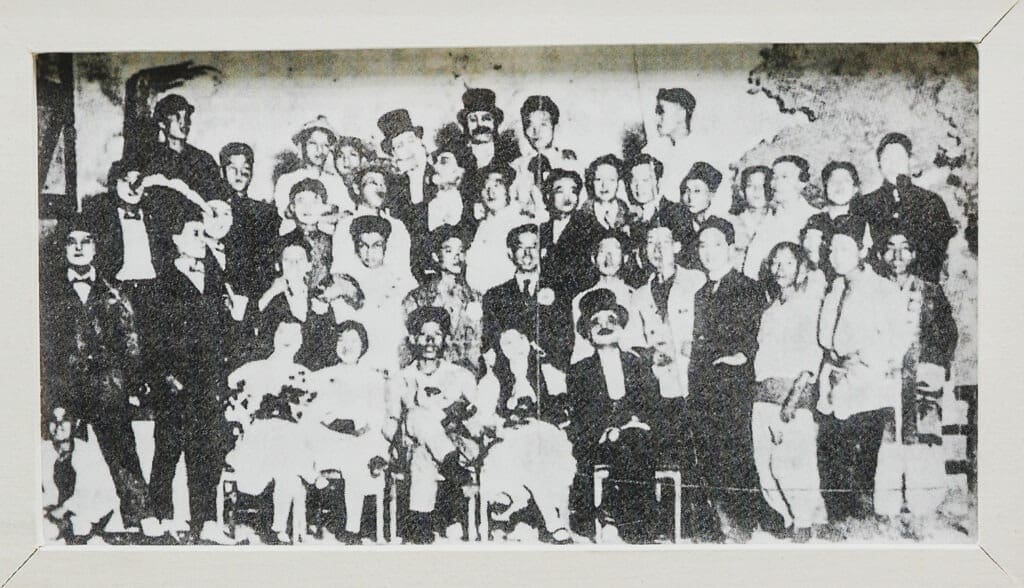
Then came the following summer. The Dong-u-hoe Theater Troupe came to Korea for a touring performance. At that time, he held the responsibility of stage director. For over a month we shared hardships together, traveling from place to place. Even then, among the dozens of troupe members—that motley crew—he alone appeared to me as a truly solid person.
And there was one fleeting impression from that time that I can never forget. We were returning from Tongyeong to Masan by night ferry. It was nearly dawn when I went up on deck, and just then he popped out from somewhere too—apparently just risen from bed. (Anyone’s face, just awakened from sleep, has a certain naturalness to it, but) against the backdrop of that morning sea, his soft, dusky face and those dark, blinking eyes gave me an instant impression: ‘What an innocent, sweet, adorable child!’ I thought to myself, and greeted him with a quiet smile. This impression of an innocent, adorable child has never left me.
Later, a group formed among us literary youths. There were several people, but at the core were he, myself, and also Mr. Nam Jun-u. (Mr. Nam, too, has been dead for some months now. This Mr. Nam was my childhood friend, a light of talent, and a friend who stirred the feelings of first love through his friendship.) I have lost both of these friends, and when I think of them, I look back at myself and lament endlessly that I am a man with no fortune in friendship.
When we three gathered, Mr. Nam and Mr. Kim would often spark lively debates. To put it simply, Mr. Nam was a man of brilliance, and Mr. Kim was a man of deliberation. The former was one who soared and fluttered; the latter sank deep within. If the former had breadth, the latter had depth. If the former was transcendent of reality, the latter was realistic through and through. From the differences in their characters and ideas arose rebuttals and counter-arguments. As I sat watching these two good friends argue and carry on, there was nothing more entertaining and delightful.
——————
After that, I returned to Korea first. He stayed on for another year or two to finish his studies. During those one or two years, we could not even exchange letters. I heard through the grapevine that he had finished school and was at home managing the family estate. I was startled to hear this.
‘Is this temporary? Or permanent?’ I wondered, and even as doubt arose, a sense of indignation flared up at what felt like the betrayal of some expectation. I immediately took up my pen and wrote him a postcard full of severe scolding and reproach. His reply came promptly. He said he had wept upon reading my letter … that he had, for the first time, discovered a true friend in this world … From that point on, I too felt as though I had regained a friend I had nearly lost.
While he was buried in his household and away from his desk, his inner suffering must have been no small thing. He was a person who could see himself and his circumstances clearly. He was a person given to deep self-reflection. And because of that, the contradictions and collisions between his thoughts and his family situation grew ever more violent. As he himself once said, ‘When the anguish of my heart becomes unbearable, I want to chew my own flesh’—that is how much he suffered. Yet he endured, telling himself to bear it unto death.
He was a person of great endurance. Submission and resistance—for all but the most critical matters, he submitted to everything. Yes. He only rose in resistance at the very last extremity.
This is what strong people do.
It was around the end of May last year, I believe. A letter arrived saying he was suddenly coming to Seoul, followed almost immediately by a telegram. I went out to the train station early in the morning, met him, and we went together to an inn. It was then that I first realized he intended to leave home, and I was secretly glad. I had always held the private expectation that such a day would surely come.
At that time, he had resolved to set aside what he had long aspired to—his ambitions in theater arts, which he had been studying all along, as well as his plans to channel other resources like capital into launching a theater movement in Korea—and to first rescue his own life from its suffering. He intended to go somewhere like Russia, to set right the life that had never suited him, and also to further his studies in his chosen field. And so he cast everything aside. He abandoned his property, his family, and everything else …
He would have headed north immediately, but due to matters of introduction and other circumstances, he first spent a few months in places like Tokyo, preparing his language studies. He planned to head north by September of that year at the latest. But then—could he have imagined it even in his dreams?—on the afternoon of August 5th, the news that he had died reached my ears and shook me.
A full year has passed since then. Last August 4th was the first anniversary of the day he died. That day, too, has already slipped by over a month ago. In time, even when that day comes around, it will likely be forgotten more often than not.
——————
Let me, one last time, recite the memorial tribute:
“Su-san was sincere as a human being. His sincerity was such that it could dispel the falsehood of those around him. Su-san was my most trusted, irreplaceable friend. I believed that trust would last a lifetime.
Yet Su-san has been dead for a long time now.
His tightly closed lips, those shining dark eyes rise before me once again.
Su-san! The path ahead of you is forever empty. My own steps feel hollow and lost!”
August 27, 1927
Joseon Jigwang (Light of Korea), No. 71, September 1927
————————————
Notes
This essay was written by Jo Myeong-hui (1894–1938), one of the leading figures of early modern Korean literature. Jo was a poet, novelist, and activist who eventually crossed into the Soviet Union in 1928, where he continued his literary activities among the Korean diaspora before his death during the Stalinist purges.
The subject of the essay, referred to throughout by the pen name Su-san (수산), was Kim U-jin (1897–1926), one of the pioneering figures of modern Korean drama. Kim U-jin studied English literature at Waseda University in Tokyo and was deeply involved with the Dong-u-hoe (Fellowship Society), a Korean students’ cultural organization. He served as stage director for their first touring theater troupe, which traveled throughout Korea in 1921.
Kim U-jin was a playwright, critic, and theater theorist who championed Western-influenced modern drama in Korea. On August 4, 1926, Kim U-jin died alongside the renowned soprano Yun Sim-deok when both drowned in the Genkai Sea after apparently jumping from the ferry Tokuju Maru on the voyage between Shimonoseki and Busan. Their deaths—widely interpreted as a double suicide—became one of the most discussed tragedies of the colonial era and generated enormous public sensation and speculation. Jo Myeong-hui’s pointed refusal to discuss the circumstances of the death, and his frustration with sensationalized press coverage, are clearly directed at this public frenzy. His essay is a deliberate attempt to reclaim his friend’s memory from scandal and restore it to the domain of personal integrity and literary fellowship.
Nam Jun-u, also mentioned in the essay, was another close friend of Jo Myeong-hui’s and a member of their literary circle. He too died young, a recurring tragedy in this generation of Korean intellectuals under colonial rule.
The essay was originally published in Joseon Jigwang, a prominent Korean intellectual journal of the colonial period. This translation is based on the text as reproduced in the Collected Works of Jo Myeong-hui.