She’s not sure how old she was when she first learned to swim. She must have been about four years old. She remembers the one-piece swimsuit: the top half is solid white with red polka dots and the bottom half is red with white polka dots. Her small arms are buoyed by two inflatable plastic rings. Her mom steadies her in the water and then withdraws. Supported by the floaties on each arm, she churns about in the water. Someone hands her a styrofoam board and she maneuvers it beneath her body. She kicks randomly and hobbles around in small circles through the water like a baby duck with a missing leg. She can recall these moments too—when she suspends herself upon her stomach and the swimming teacher floats her at the water’s surface so she can practice her breaths. With her face above water she inhales, holds her breath, submerges her face, then lifts it to one side, exhales, inhales, and repeats.
In the summers, they go to Catalina Swim Club. It smells of fresh cut grass because there is always some high school student employed for the season on a riding lawn mower, plowing long, neat rows in the lawn. She remembers: the manufactured coconut scent of sunscreen, paired with fresh cut grass, and the chlorine wafting around.
The girl is riding in the passenger seat with her mom at the wheel. Her face is a flower unfurling for the nourishment of light and air as she turns herself toward the open window. Her mom is wearing a modest one-piece swimsuit, a white terrycloth coverup robe, a sunhat, and oversized sunglasses. The girl can tell they are getting close as the car turns down the long two-lane road that leads to the pool. She loves this road because it means that very soon she will feel free, submerged in cool water like a second skin. The long road is hidden within a tunnel of trees, sunlight stutters in her eyes, her vision awash in a sea of greens, browns, yellows that stream past the car window.
They arrive in the parking lot, a treeless place flooded by light. Her mom parks the car and they gather their things. She follows her mom into the reception office to sign in. On the clipboard she scribbles her name in large letters: Suseong O. They walk down the concrete hallway into the ladies’ changing room, where the floors and surfaces are always covered in layers of moisture. A draft of wind blows through the open doorways and carries with it the smell of chlorine and the distant sounds of children squealing as they cannonball into the water.
I’ll be out there soon! she thinks to herself as her mother adjusts her sunhat in the bathroom mirror.
The girl is nine years old now. She has been coming to this pool for more than half her life. She is fairly confident in her swimming abilities, and especially loves to do the breaststroke. She can’t quite get the butterfly, but that is fine. She is not ambitious about swimming, she just wants to be in the water to float and glide about.
What she would like most is to swim in the ocean. Here in Iowa, there are no oceans. They are in the territory of reservoirs, ponds, or lakes. She longs for the wild, open sea. She thinks that the best life to live is in California, where beaches and the ocean are just everyday. You walk outside and it’s all sun, surf, bleached blonde hair, sun-kissed skin. She listens to The Beach Boys and even fantasizes about becoming a dolphin trainer. She is pretty confident that this is what she wants to do when she grows up. She wants Southern California to be her entire world. She wants it to be where she is from, with surf boards and kids who seem kind of wild, kind of mysterious, and all laid back.
But, it’s not where she is from.
She thinks she is from this place called Iowa, and no one has ever made her feel otherwise.
But there was that one time when she was walking with her father in the mall. Some white man walked by them and muttered, “fucking chinks.” Her body clenched and she looked up at her father. She knew this was not a good thing to say, but did not know exactly what it meant. Her father hardened into stoicism. He set his jaw and held his head high, his gaze fixed forward toward the ice cream store where he bought her a scoop of strawberry swirl on a sugar cone and imagined what he could do to that man.
For now, she is at Catalina where the grass is always freshly cut and there are endless hot dogs and nachos with the bright orange processed cheese liquid. She will swim until the whistle blows and all the kids have to get out for ten minutes. Her mom doesn’t swim, but she will wade. She glides into the water at the shallow end and walks around, cooling her skin warmed by the summer sun. After five minutes, she lifts herself out of the pool and returns to her lounge chair. She shields her entire face and body from the sun. The girl observes her mom, how elegant she is in her one-piece navy blue swimsuit with the triangular white lines on the front, her tortoise-shell sunglasses with the oversized hexagonal lenses, and the sun hat with a tilted, swooping brim. She looks like a movie star, not like a nurse. She seems content here, at peace, and the girl only sees her mother like this here. This place is where her mother is not tight and wound up like she is so often at home, where she lives as a hummingbird, in constant motion.
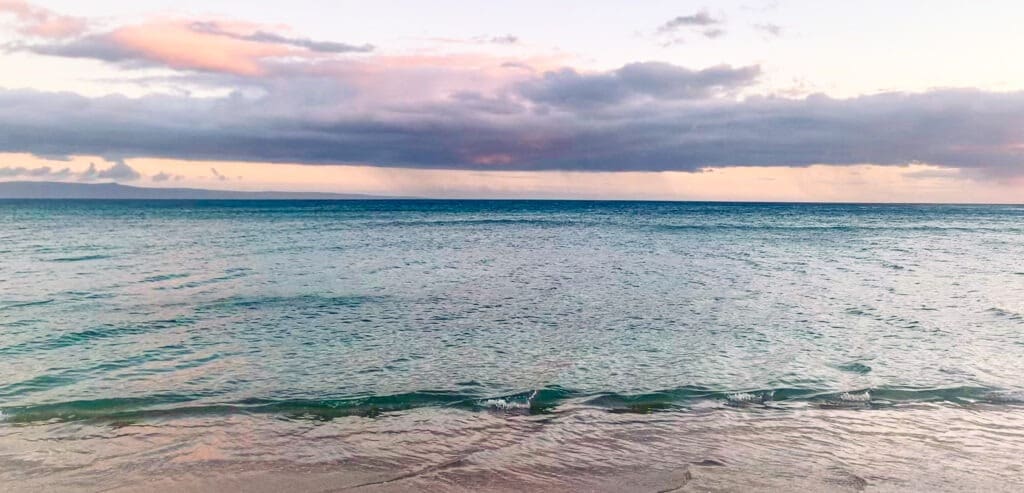
The girl would be thirteen years old by the time she swam in the ocean for the first time. The only time she had ever felt water that soft and warm was in the bath. She licks a faint layer of salt from her lips and picks up matte white shells like small treasures left for her to find. By the end of the five day vacation, her skin is brown from hours lost to the sun.
It would be many years until she would be in the ocean again—she thinks of them as her lost sea years. This was a time when anything related to the body—exposing it, caring for it, being active or athletic in any way, remembering she had one—vanished from her reality. She did not go into a body of water, aside from the occasional bathtub, between the ages of 14 and 21. During these years the girl devoted herself to the life of the mind, living only in the imaginal worlds of words—of poetry and theatre through Plath, Atwood, Whitman, cummings, Shakespeare, Beckett, and the like—so much so that the fact of her body simply slipped her mind. She became a vegetarian in a Korean-Midwestern household, so she sustained herself on breads, pasta, and tofu for basic sustenance. She received a steady transmission of messages from people around her, through little side comments and big confrontational criticisms, that her body was ugly and shameful, so she hid it away from everyone, submerging herself in the life of her mind, during those lost sea years.
~ ~ ~
When the girl is just shy of her 18th birthday, she is in Busan, South Korea. It is a balmy humid afternoon, and she sits on a beach, fully clothed in black, with a group of friends, also fully clothed. They watch Korean people enjoying the ocean views as they walk along the beach. These people are also all fully clothed. Every one of them, on a hot sunny day, lazing around on the beach in their street clothes.
Then suddenly a woman who has stripped down to a black slip and underwear rises up out of the water. Her voice is deep and guttural, she is wailing out some songs. She gesticulates at the vast expanse before her, her arms flung open at the sky and her exultations roll through the ocean waves. She is a wild water banshee or a saint pleading for the sky gods to take her. She is a sight to behold, a spectacle, and a wonder, as she faces out toward the open ocean, keening and hurling sounds both melodic and primal. All the people on the beach gawk and jeer at her, this crazy woman in the sea.
The girl and her friends watch the woman in silence, transfixed. The girl thinks, if this woman is crazy, it is probably a very good kind of crazy, one that she’d like to know about. Once the woman’s songs to the ocean are complete, she approaches the girl and her friends and asks for a cigarette. They welcome her with an unspoken familiarity, as if to say, We get you; you are a pariah here, just like us.
She tells them she has just divorced her husband, who subjected her to years of abuse and submission. She just broke one day, couldn’t take it anymore. She has also won custody of her son—a rarity in Korea, where family law by default gives custodial rights to the father when a marriage dissolves. She is a woman who has fought and freed herself. Her message to the girls in the friend group is clear: never, ever let a man ruin your life. Get educated, make your own money, have a career, live on your own terms. Meeting this woman confirms the girl’s belief that the ocean is the most powerful force on the planet.
~ ~ ~
Now the girl has entered womanhood and she swims again, this time in the Adriatic Sea. She is 21 years old, with two friends, on a pitch black night. The three of them had come to the Croatian island of Brač to film a documentary about an old former Croatian Army General who spent his twilight years arguing with family members about former Yugoslavian politics and carving immense and exquisite objects from alabaster stone.
One night, her friend says, Get in the car. I have something to show you. And they drive across hilly roads in the darkness to an empty beach. The waters are quiet, utterly still, and the night so dark, they can’t make out where the sea and the sand meet. Approaching slowly, each step requires risk and trust that their feet will find the water. And at last, when it does, the warmest calming sensation cocoons her. She sinks in, guided by this felt sense, yearning for more even as she is already in it. The stars sharpen in their multitudes above her as the salty sea water’s bioluminescence inks the movements of her arms and legs, creating the optical illusion of being engulfed in a never-ending blanket of black night threaded in dazzling patterns of silvery pearls and glowing white lines. She had been suffering a very bad skin rash on her arms due to constant exposure to heat and moisture, something she had endured since childhood, but the next morning, her skin is completely smooth and new.
More than twenty years later, she does not hesitate to swim. If there is an ocean nearby, she can sense it in her entire body. She longs for it, feels a magnetic pull and a vibrational resonance. Her favorite thing is to dive under the water and go as deep as she can. Because she never has the right gear, and does not have the lungs of a haenyeo, she can’t really stay under for long. Though if she could, she would. Or she simply floats upon the salt water surface, the soft waves undulate beneath her body. She surrenders here, it is the easiest place for her to do so.
She knows that she needs to surrender here because she has had one recurring dream — or variation of the dream—for almost 25 years. In it, she finds herself at an ocean, she looks out, there are thousands of dolphins, tens of thousands of them. They surge and arc out of the water, slicing through it. It is euphoric. She knows she has to be in there with them. This becomes the story of the dream: she must get in the water with them, it is a spiritual imperative, her only reason to exist. Sometimes she can just dive in and the dolphins surround her. She can feel their leathery, silky smooth skin skimming against hers. She is utterly elated. It’s the feeling of night swimming in the Adriatic Sea multiplied by infinite degrees of bliss.
There are other versions of this dream in which she cannot get access to the water with the euphoric dolphins because there is an ever-unfolding array of obstacles in her way, and she spends the entire dream thwarted by random things and people or roads that disappear. Sometimes there are sea turtles and whales in the waters, humpbacks that breach and arrest themselves midair to lock eyes with her.
The ocean says, Release all the samsaric ways you grasp and cling and plan and avert; all of the ways you try to deny the reality of your situation. I am great in force, in beauty, in wildness; give your suffering and your hopes over to me.
Being in the ocean feels like coming home, akin to returning home to her mother and father; to the unending, steadfast love and care that has survived its own tumultuous, primal nature. Floating, breathing, maneuvering with its flow when the waters engulf her. In the ocean, she knows there is power and there are secrets. To access them, she has to let go of everything that she thinks she knows. Because sometimes she must risk before she can trust, and not the other way around.